
The Identity Wobble (a story about a sauna, six young men, and a lesson learnt)
By Kat Van Dijk | katvandijk.com
A couple of weeks ago my lovely friend Jen invited me to her gym. Not just any gym, a seriously swanky, multi-level, air-conditioned, aesthetically pleasing gym. We had a wonderful workout, chatting away, feeling energised and genuinely great.
And then Jen suggested the recovery area.
I put on my togs, the very Kiwi term for swimsuit, and we headed towards the sauna. Through the glass I could clearly see six young men inside. I stopped.
"Are we going in there?" I asked.
"Yes!" said Jen, with the easy confidence of someone whose nervous system had not just quietly pinged an alarm.
Mine had. A flash of self-consciousness about my older skin, my changed body, standing in a swimsuit in a room full of young strangers. I noticed it immediately for what it was: an old story, surfacing right on cue.
Jen made a considered choice in that moment and I took it, rather than pushing through in a way that felt performative, or retreat in a way that felt like defeat, we headed to the private pool instead and afterwards I sat with what had come up.
Because that is the part that matters, not the internal flicker, but what you do with it.
This is what I call an identity wobble. I teach this work. I have spent years studying identity, building frameworks around it, and helping others move through exactly these kinds of moments. And I still get caught out occasionally. The thing about identity work, is knowing it and living it are two very different things.
What is an identity wobble?
An identity wobble is what happens when your external environment collides with an unresolved internal story. It’s not a breakdown, it’s a signal. Your nervous system is telling you that something in your self-concept still needs attention.
In my case, once I gave it space to process, I could see it clearly. The trigger was not really about the young men. It was about old stories I was still carrying, fear of not being enough, of not fully accepting the natural changes in my body, of being measured against a standard I had absorbed somewhere along the way and never quite released.
Old programming, running quietly in the background, waiting for the right moment to remind me it was still there.
In the weeks since I have gone deeper into my own work. Rewiring some of the subconscious thinking. Practising genuine self-acceptance rather than performing it. Deepening my meditation practice, with a focus on gratitude, because I have an extraordinary amount to be grateful for, including a body that is strong, healthy and carries me through this life.
I’m sharing this because I don’t think I am alone in this. Most women will recognise this moment in some form. I want you to know, even the person who builds frameworks around identity still has days where an old story catches her off guard. That is not a contradiction, that is just being human. The difference is in how quickly you catch it, name it, and choose what comes next.
What is actually happening in your brain
Understanding the neuroscience behind an identity wobble makes it significantly less frightening and significantly more workable.
When we experience a trigger, a situation that presses on an unresolved story, the limbic system activates very quickly. This is the emotional, survival-focused part of the brain. It is ancient, fast, and designed to protect us. It doesn’t pause to ask whether the threat is real. It simply responds.
The prefrontal cortex, the part of the brain responsible for reasoning, self-awareness and conscious decision-making, takes a little longer to come online. Which means that without a deliberate pause, we stay in that reactive, emotionally flooded state, running on old programming rather than our chosen identity.
This is why the reaction can feel so total, so fast, and so difficult to reason with in the moment. It is not weakness. It is neurology.
Between the trigger and your response, there is a gap. Most of us move through that gap unconsciously. But when you slow it down, even slightly, you give your prefrontal cortex time to come back online. That is a neurological shift from reaction to conscious response. The pause is not just a mindset tool, it is biology.
In my work, I call this identity drift, the moment when even someone who has done deep identity work momentarily falls back into an old pattern. It happens to everyone. And the key reframe is this: noticing the drift is not a sign that you have gone backwards. It is the work. The moment you notice, you have already created the gap. And in that gap, you have a choice.
Three steps to move through it
When an identity wobble hits, I teach a simple three-part system from Stage Two of the LIFE Design Method™. It is not about suppressing what you feel, it’s about working with it intelligently.
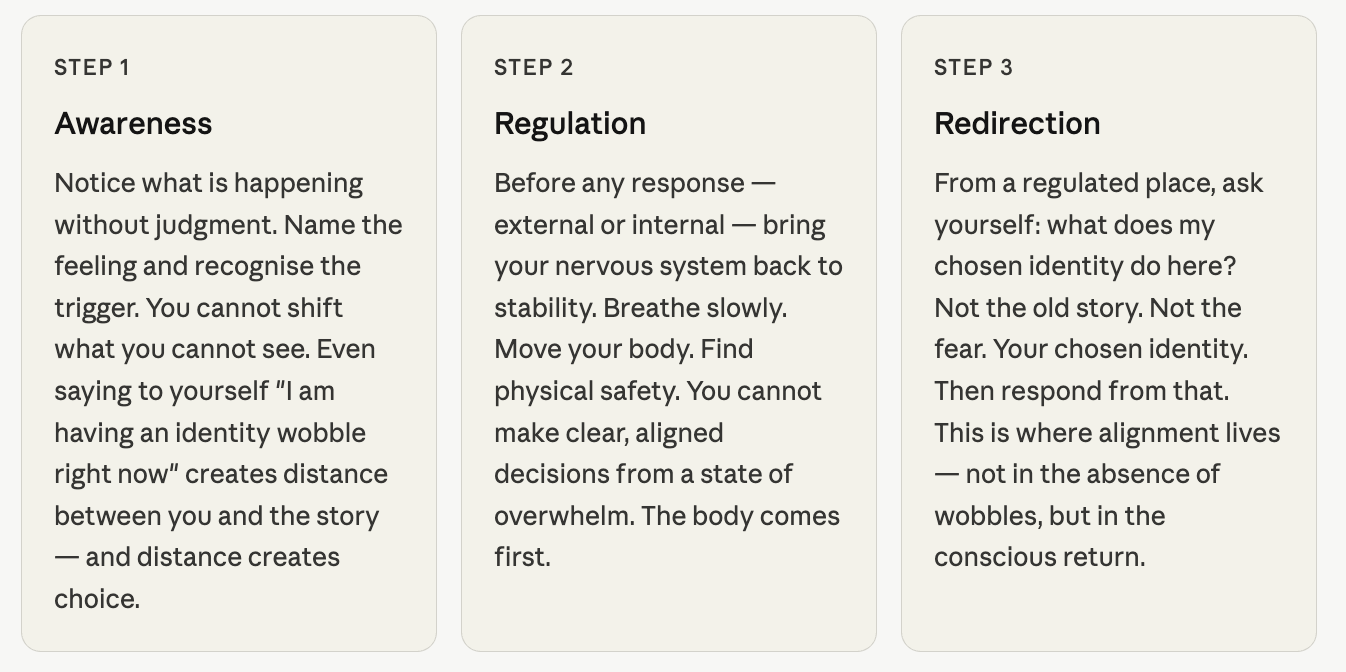
In my sauna moment I caught the trigger quickly, made a conscious choice rather than a reactive one and used the space afterwards to process what had surfaced and go deeper. Not perfectly executed but intentional and that is exactly the point. If this resonates, here are some questions worth exploring. You might want to journal on them or simply let them settle quietly.
Reflection
When did you last experience an identity wobble? What was the trigger?
What old story was underneath it, the one the trigger pressed on?
How quickly did you notice what was happening? What helped you regulate?
What would your chosen identity have done in that moment?
Is there a pattern worth looking at more deeply?
If this work resonates and you want to go deeper, Stage Two of the LIFE Design Method™ , The Integration™, covers exactly this territory in full and if you are not sure where to start, take the free LIFE Diagnostic Test will give you a clear picture of where you currently are.
The LIFE Diagnostic Test takes less than ten minutes, find out which of the five archetypes you are.